
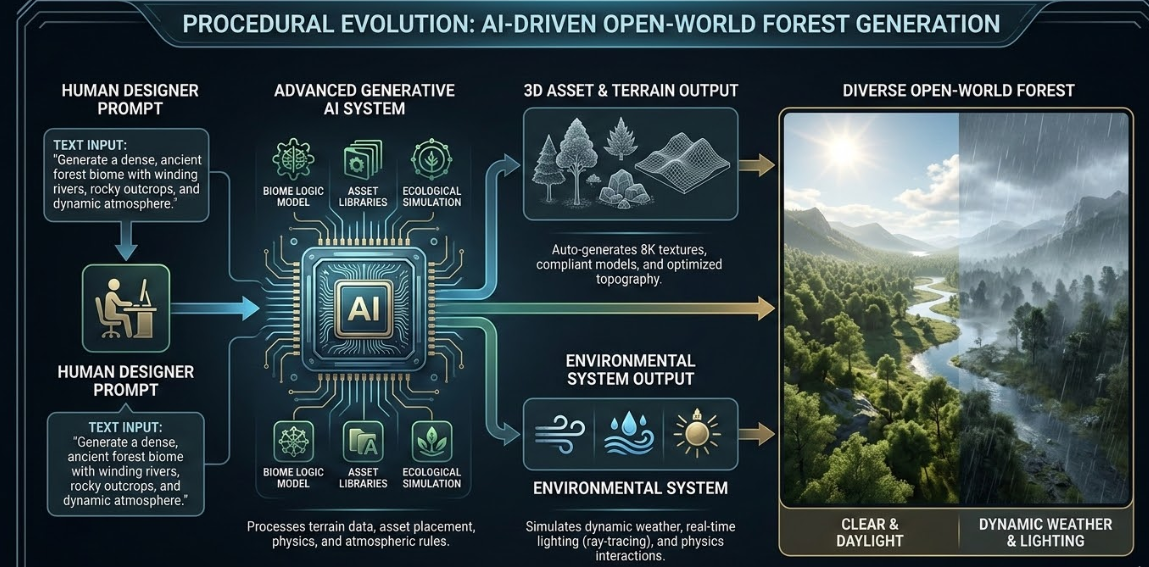
The gaming industry is currently navigating its most significant evolution since the transition from 2D sprites to 3D polygons. If you’ve spent any time in Discord servers or following dev-logs in 2026, you’ve encountered the polarizing debate surrounding Generative AI, Neural Networks, and Automated Asset Creation. For decades, the development of a triple-A title like The Witcher or Grand Theft Auto required thousands of developers working in high-pressure “crunch” environments to manually place every blade of grass and script every NPC interaction. Today, as we look toward the horizon of game design, a fundamental question emerges: Is the human designer becoming an endangered species?
The shift we are witnessing isn’t merely about increasing the speed of production; it is about a total paradigm shift in the creative process. When we discuss Generative AI in the context of gaming, we aren’t just talking about sophisticated “copy-paste” tools. We are talking about intelligent systems capable of analyzing vast datasets of art and logic to “dream up” entirely new assets that feel organic. For university students pursuing degrees in Game Design or Computer Science, this transition is both a golden opportunity and a source of intense academic stress. Many students find themselves buried under the weight of learning these new technical workflows, often relying on assignment writing services like myassignmenthelp to manage their complex research papers so they can spend more hands-on time mastering AI-driven engines.
The Architecture of AI-Native Development
In the early eras of gaming, “AI” was a misnomer. It referred to basic “if-then” logic—a ghost in Pac-Man following a fixed path or a guard in Metal Gear Solid turning his head at a specific coordinate. In 2026, we have entered the age of AI-native development. This means the game engine itself—the very “brain” of the software—is capable of real-time reasoning.
Developers are now integrating Large Language Models (LLMs) directly into the gameplay loop to create “Living NPCs.” Imagine an RPG where you can walk up to a local blacksmith and have a completely unscripted conversation. The NPC doesn’t just cycle through three lines of text; it remembers your previous deeds, notices the blood on your sword, and adjusts its tone based on your reputation in that specific village. This is the pinnacle of dynamic storytelling.
Table 1: Human vs. AI Roles in 2026 Game Development
| Feature | Traditional Human Method | 2026 AI-Assisted Method |
| World Building | Manual placement of every 3D asset. | Procedural generation via text-to-world prompts. |
| NPC Dialogue | Thousands of pages of static branching scripts. | Real-time generative dialogue based on player intent. |
| Bug Testing | Humans playing levels for thousands of hours. | AI agents simulating millions of playthroughs in minutes. |
| Art Assets | Concept artists drawing dozens of iterations. | Generative models creating variations in seconds. |
Procedural Content Generation (PCG) on Steroids
We’ve had procedural generation since the days of Rogue and No Man’s Sky, but modern AI has taken this to a level that is indistinguishable from human hand-crafting. In the past, a level designer had to spend weeks ensuring that a forest looked “natural”—varying the height of trees, the density of moss, and the flow of water.
Today, a designer acts as a high-level conductor. They provide the “seed” and the constraints, and the AI populates the world with 8K textures and physics-compliant 3D models. This saves tens of millions of dollars in production costs. However, this efficiency creates a high barrier to entry for students. Understanding the underlying physics and mathematics of these engines is a grueling task. If you are struggling to keep up with the logic of these systems, seeking programming assignment help can provide the necessary academic cushion, ensuring you pass your technical modules while you focus on the creative direction of your game projects.
The “Human Spark”: Why the Director’s Chair is Safe
Despite the staggering power of neural networks, there is a “ghost in the machine” problem: AI lacks Intent. An AI can generate a breathtaking mountain range, but it doesn’t understand why that mountain range should feel intimidating to the player. It doesn’t understand the emotional payoff of a hard-earned victory or the subtle humor found in environmental storytelling.
Human designers are transitioning from “builders” to “curators.” The job is no longer about “how to make a tree,” but rather “why this tree belongs here.” This requires a deep understanding of psychology, color theory, and narrative pacing—skills that are still uniquely human.
The Economic Impact: Job Displacement vs. Job Evolution
The most common fear is that AI will “steal” jobs. While it is true that entry-level “grunt work” roles—like basic asset cleanup or repetitive QA testing—are being automated, new roles are emerging that didn’t exist three years ago.
1. The Prompt Architect
Gaming studios are now hiring specialists who understand the “linguistics of logic.” These architects know exactly how to prompt an AI model to generate a level that is both beautiful and playable. This requires a mix of creative writing and technical engineering.
2. The AI Ethicist
With the rise of generative models comes the massive problem of data scraping and copyright. If an AI generates a hero character that looks suspiciously like a mix of three different copyrighted icons, who is liable? 2026 has seen a surge in “Legal Tech” roles within gaming to ensure all generated content is “clean” and ethically sourced.
3. Procedural Storytellers
Instead of writing a fixed script, writers are now “teaching” AI the personality traits of characters. They write the “soul” of the character—their fears, motivations, and speech patterns—and the AI handles the execution during gameplay.
The Player’s Perspective: A New Golden Age
For the person holding the controller, the future of AI in game development is nothing short of a miracle. We are moving away from “static” games that are the same for everyone and toward “liquid” games.
- Personalized Difficulty: AI can analyze your heart rate (via wearable tech) or your input speed to adjust the game’s difficulty in real-time, ensuring you are always in a state of “flow”—neither too bored nor too frustrated.
- Infinite Content: Imagine a game that never ends because the AI is constantly building new continents, quests, and lore that react to what you’ve already done.
- Hyper-Realism: AI-driven physics engines can now simulate liquid, fabric, and light with 100% accuracy, creating immersion that was previously impossible.
The Academic Challenge of the AI Era
As the gaming industry becomes more technical, the education system is struggling to keep pace. Students are expected to be master coders, 3D artists, and AI prompt engineers all at once. This multidisciplinary demand is why many choose to supplement their learning with professional guidance. Whether it’s a deep dive into Programming assignment help for a C++ module or a complex ethics paper, having an expert touch ensures that the next generation of designers is actually ready for the 2026 job market.
Conclusion: Will AI Replace Us?
The short answer is: AI will not replace game designers, but game designers who use AI will replace those who don’t. We are not witnessing the death of human creativity; we are witnessing its liberation. By delegating the “boring” parts of development to intelligent machines, we are opening the door for more ambitious, emotional, and complex games than ever before. The “human touch” is the most valuable asset in the industry. It is the bridge between a collection of pixels and a meaningful experience.
As long as humans want to tell stories and players want to feel something, there will always be a human at the heart of game design. The tools have changed, but the goal remains the same: to create worlds that we never want to leave.
Frequently Asked Questions
Does AI have the ability to create entire games independently?
Currently, AI is used to generate specific assets like textures, dialogue, or level layouts. However, it still lacks the high-level creative vision and “fun factor” that only human designers can provide to ensure a game is engaging and cohesive.
Will entry-level design roles disappear because of automation?
Roles are evolving rather than disappearing. While manual “grunt work” is being automated, new opportunities are emerging for specialists who can manage AI tools, curate generated content, and oversee complex technical systems.
How does generative AI improve the player experience?
It allows for more personalized gameplay, such as NPCs that respond to unique player choices in real-time and dynamic environments that adapt to a user’s skill level, making every playthrough feel distinct.
Can AI-generated content be legally protected?
The legal landscape is still shifting. While copyright laws traditionally protect human-made work, many studios are now using “clean” data models to ensure that the content generated by their AI systems remains legally sound and ethically sourced.




Leave a Reply